Siddha Therapy and its effect on Lumbar Spondylosis in an Obese Patient
Abstract
Objective: This study seeks to find out the impact of Siddha Varmam techniques on the symptoms of pain, ROM (range of movement), stiffness muscular hypertonicity, and structural misalignment associated with chronic lower back pain due to lumbar spondylosis (Thandagavatham).
Methods: A 45-year-old obese female was diagnosed with L5-S1 disk degeneration, has chronic lower back pain radiating into both legs during prolonged walking and standing, hyperlordosis and swelling in both feet. A one month treatment with two breaks in between including energy techniques and varmam therapy which is a therapeutic manipulation of varmam points was carried out, measuring the length of standing/walking time, sleeping time, standing time before & after treatment.
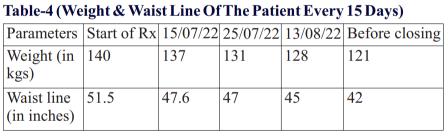
Results: The onset of low back pain was delayed and the pain on VAS scale reduced from severe to moderately mild during walking/standing over the course of treatment, hyperlordosis decreased, rigidity and hypertonicity of thigh muscles decreased. The patient’s weight which was 140 kgs at start had reduced to 120 kgs by diet management.
Conclusion: This study concludes that there is a positive role Conclusion: of Siddha in treatment of Lumbar spondylolysis. There is a positive sign in reduction in pain severity, stiffness, ROM of legs and normalizing postural misalignment associated with hyperlordosis. It also highlights the importance of Siddha in weight reduction by regular pressure massage technique along with Diet restrictions and exercises. Since, very less data are available and future research is needed to support the efficacy of siddha therapy as a conservative strategy and alternative option for lumbar spondylolysis.
Introduction
‘Spondylosis’ means vertebrae in Greek, ‘lysis’ is a break, and ‘olisthesis’ means to slip or move. Spondylosis is considered as a degenerative condition of any part of spine affecting the disks, vertebral bodies, and/or associated joints of the lumbar spine. This causes degenerative disk or disk herniation, formation of osteophytes, sciatica (Vathasthambam), lumbar stenosis, spondylolisthesis causing chronic lower back pain which may or may not migrate into legs, restriction in ROM and in later stages functional limitations. In recent times, there is a tremendous increase in considerable number of people suffering from low back pain owing to work culture and lethargy. Risk factors include female gender, older age, obesity, prior history of back pain, restricted spinal mobility, high levels of psychological distress and minimal physical activity. 70-80% of adults experience low back pain at least once in their lifetime due to aging and reduced spinal strength.
Obesity or more body weight is a weak risk factor leading to lower back pain but recent studies show there is a positive relation between obesity & associated musculoskeletal disorders, including impairment of the spine. It was observed that being persistently overweight was associated with disk degeneration in many MRI reports. Obese patients show a hyperlordosis of the lumbar spine and affects common daily movements, such as standing, walking, lateral bending, and forward flexion. Few studies demonstrate a correlation between obesity and functional impairment of the spine secondary to weakness and stiffness of the lumbar muscles, possibly leading to lower back pain and disability in advance stages.
In allopathy, possible treatments of lower back pain include Transcutaneous electrical nerve stimulation (TENS), Lumbar supports, Traction, Spine manipulation, Injection therapy, NSAIDS steroids and surgery as the last resort. Some studies revealed that exercise combined with mobilization/manipulation demonstrated either intermediate or long-term benefits. However, there remains controversy as to the efficacy of these procedures in resolving chronic low back and often seen there is no complete cure for this condition. Similarly, surgery causes destruction to the tissues and muscles hence, there by increases the morbidity. Hence, there is need to explore alternative treatment modalities for the holistic management of Lumbar Spondylosis.
There are a number of systems of medicine prevailing all over the world as alternative treatment methods for Lumbar Spondylosis. Homoeopathy, Ayurveda, Physiotherapy and Chiropractition are few which are generally known in chronic conditions. In Siddha literature, Lumbar Spondylosis is termed as Thandagavatham and is explained by increased Vatham. Recently, Siddha has gained its fame in South Indian region and Malaysia as a holistic treatment modality for such cases. Siddha system is bestowed with various special therapies of few which are Pressure Manipulaiton Therapy (Varmam), Physical Manipulation Therapy (Thokkanam), Pranayamam and Yoga that have proved to be beneficial in managing the symptoms of chronic disease like LBP. Varmam therapy is a drugless, non-invasive, simple therapy used in pain management by pressing, massaging, tapping & lifting.
In Siddha, the therapeutic stimulation of specific energy points (Thodu Varmam – junction of muscles, nerves, veins, arteries, capillaries) where the pranic energy or vital energy is stored through which energy is transmitted to various parts of the body and all the functions of the body are mediated. These points when stimulated increase the flow of energy, heal disease or boost the immune mechanism. Thokkanam is one of the 32 external therapies in Siddha concurrent to pressure manipulation therapy where external pressure is applied.
This study seeks to find out the impact of Siddha Varmam techniques on the symptoms of pain, ROM (range of movement), stiffness muscular hypertonicity, and structural misalignment associated with chronic lower back pain due to lumbar spondylosis (Thandagavatham).
Case Presentation
A 45-year-old obese U.S female patient came to Chakrasiddh in July, 2022 with complaints of severe lower back pain. She was apparently normal six years back, but gradually noticed pain in the lower back region with difficulty in walking and standing since 4 years. In few months the pain got aggravated and there was difficulty in walking with severe stiffness in thighs and lower back region. The pain was insidious in onset and gradually progressive in nature with an intensity of 9 (severe) on VAS pain rating scale. She had difculty in doing any activity like walking, standing or sitting, bending and had continuous dull pain in both legs. She was unable to squat and could not climb stairs. The pain use to partially reduce on taking rest and medications.
Due to weight increase in last few years, she has started bending forward and feels that her spine is misaligned, a slight scoliosis was visible.
The patient is staying in U.S and she has to do all household chores herself but due to her condition she is unable to perform them properly. As the responsibility of the household was on her shoulders she had immense psychological stress which led to depression and deterioration in her quality of life.
History Of Past Medical Illness
The patient has diabetes and has Hypothyroidism from past 10 yrs. She has a H/o Left Mastectomy and Lymphadenectomy in 2008. In 2019, her Gall bladder was removed and Hysterectomy was performed. She observed after her surgery, her pain in both legs and back has aggravated with restricted movements. She observed her weight also increased immensely from 90 kgs to 140 kgs. The left arm has swelling due to Lymphedema and she is unable to work with left hand. There is numbness and heaviness in left arm, she is advised to wear socks which has restricted her movements in hands.
In 2021, pain severity increased so she had visited orthopedic specialist in U.S who diagnosed as having Lumbar Spondylosis. She was managed accordingly with allopathic medicine, but didn’t get any relief for a longer duration. She got epidural steroid Injections twice in 2021 in a span of 6 months but with no result. The doctor advised her to reduce weight which was over 140kgs and counseled her about obesity being the cause for her increasing pain in lower back region. On advise, she started dieting for few months but weight could not be managed, instead she felt weak. The patient was unable to stand and walk for even 5 mins & could not go for walks to control her weight issues. In between, she took Homeopathic medicines for pain but they worked only for few days. She also took physical therapy for a year, got some relief but still the pain was persistent.
The Orthopaedic doctor advised for lower back surgery but patient was reluctant for the same. She continued with a course of steroids and was referred to Physical therapist to strengthen the core muscles. The patient showed minor pain reduction on warm application with exercises and some improvement in the daily activities. However, the pain progressed over last 2 years to the extent to which the patient had difficulty in day-to-day activities like standing for 5 mins, sitting, unable to sit cross-legged, and bending. During the last 2 years the pain has aggravated to a scale of nine (severe).
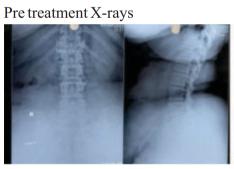
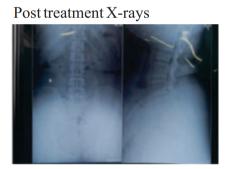
The aim of presenting this case is to see how Siddha therapy worked on curing the Lumbar Spondylosis by reducing pain and better flexibility in hip joint area without use of medicines. Also, whether siddha treatment along with diet modifications and physiotherapy is able to reduce the chances of Bariatric surgery. This was confirmed by noting her symptoms on VAS scale for pain and pre-post ROM (Range of Motion) assessment. Clinically, pre and post x-rays also verified the success of treatment. Every week, the weight of the patient was also monitored to see if the prescribed diet is working on patient in reducing her weight.
Treatment Protocol
It was a diagnosed case of lumbar spondylosis represented and amelioration by continued motion and pressure. There was relief from warm application also. The treatment was started on 13th July, 2022; it was planned for 45 days with 30 days in the initial phase and the rest of 15 days after a gap of 2 months.
The treatment included pressure manipulation at the Lumbar, B/L hips with B/L legs with not too much pressure on the hip area. The special therapies Pressure Manipulaiton Therapy (Varmam), Physical Manipulation Therapy (Thokkanam) were utilized to instigate the ow of energy. The following varmam points were stimulated to achieve a therapeutic effect in the patient; Manipooraga adangal (near umbilicus), Komberi Kallam (in calf muscles), Keel Mannai Varmam (lower to calf muscles), Kutikal varmam (near heel), Kalkulasu Varmam (joint of foot and heel), Kanpugaichal varmam, Nanganapottu (lumbosacral joint) and Poovadangal (nr to ischial tuberosity)
The patient was kept on a strict liquid diet to reduce weight and daily physio exercises for 1/2 hr. In the initial week, patient had less difference in pain but could see a difference in her walking style and standing time. She could notice that she was able to stand in the kitchen for 15 minutes while earlier she could not stand even for 5 mins. She could identify her stiffness reduction as now she was able to bend a little while earlier she could not bend at all.
In the 2nd and 3rd week, she lost 8 kgs and was now able to walk for 1/2 km with very less discomfort in her joints while before treatment she could barely walk for 5 mins. She was able to stand in kitchen for 15 mins with little discomfort and was able to do the exercises as been told by Physiotherapist otherwise earlier due to stiffness in back she was unable to continue for even 5 mins. The pain intensity which was severe (9) on VAS scale reduced to moderate (6-7) in 2 weeks and the radiating pain in her legs also reduced. From last 3 years she was not taking stairs down but now she was able to take 2 floors down. She initially complained for cramps due to wt loss but her diet was monitored by the Nutritionist.
Results
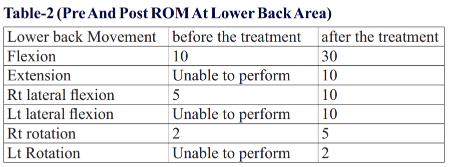
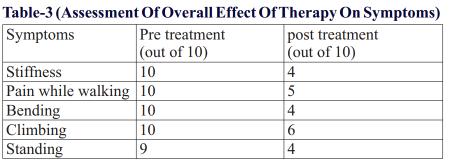
The patient showed a very good response to the treatment in 1 months time period. Overall, she felt improvement in all her complaints related to walking, standing, bending and stiffness in hip & thigh region with almost no radiating pain in legs. On the VAS scale pain had reduced from severe (9) to mild (3) (Table1) and measurement of ROM of her spine and hip joints was noted (Table 2). The stiffness in her lower back was moderately mild and was able to bend freely. The symptoms pre and pos treatment were also noted (Table 3). She was able to stand for 40 mins in kitchen and could walk for 30-40 mins in good speed with mild pain on VAS scale. She had lost total 19 kgs and was so satisfied with treatment (Table 4). The waist line was measured which reduced from 51.5” to 42” (Table 4). Clinically, pre and post x-rays also verified the success of treatment (Fig.1).